
July 10, 2026Antex facilities · Girona, Catalonia
Science and industry join forces: Plastikóre and Antex drive microplastic capture at source
Plastikóre formalises its first strategic engagement with Antex to validate the NÚCLEO module in a real industrial environment (TRL 5-6).
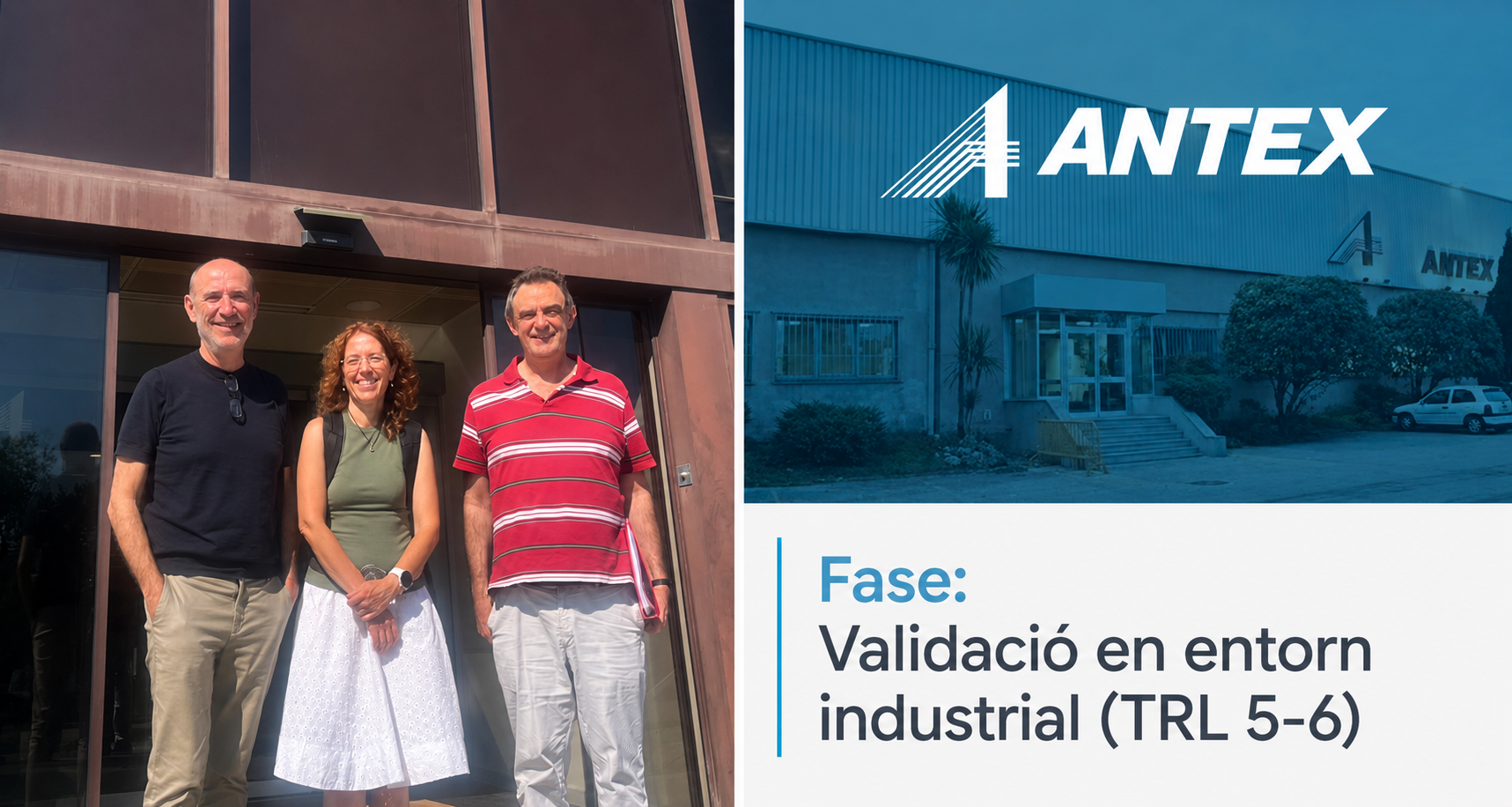
Against a backdrop of growing environmental pressure and unprecedented legislative change, Plastikóre — currently a Knowledge-Based Company (EBC) creation project · Spin-Off of the Universitat de Girona (UdG) — has formalised its first strategic engagement with Antex. This collaboration marks a turning point in the transfer of knowledge from the lab into the heart of industrial production, with the shared goal of protecting our aquatic ecosystems.
Recognised innovation: double award at SpinUOC 2026
This industrial milestone comes shortly after the project was recognised in one of the most demanding entrepreneurial ecosystems. Plastikóre was doubly awarded at SpinUOC 2026, winning the Social Impact Award and the Best Presentation Award. These prizes reinforce the viability and social value of our technological proposal, consolidating the path towards a global solution to microplastic pollution. Read more in the full news article.
Knowledge at the factory floor: the founding team on site
Plastikóre's founding team — the Universitat de Girona (UdG) researchers Jordi Colomer, Teresa Serra, Joan Josep Suñol and Lluïsa Escoda — led this technical meeting at Antex's premises. This alliance is not just a commercial agreement: it is the fusion of decades of research in physics and materials engineering with the operational experience of a leader in the textile sector. The founders' vision is clear: bring scientific precision to where the environmental impact is most critical.
The 700,000-microfibre challenge: the NÚCLEO module in action
A single industrial washing cycle can release up to 700,000 microfibres which, due to their microscopic size, often escape conventional treatment systems. To tackle this issue, Plastikóre has developed the NÚCLEO module: a compact, modular solution designed specifically for industrial effluents with a high load of synthetic fibres.
Unlike traditional alternatives, Plastikóre's technology is 100% physical, completely removing any dependency on chemical reagents. The result is 95% efficiency in microfibre capture, ensuring that textile production does not compromise the health of rivers and seas.
NÚCLEO module
95% microfibre capture, 100% physical, no chemical reagents
Directive (EU) 2024/3019
Quaternary treatment at source to get ahead of the new regulation
Getting ahead of Directive (EU) 2024/3019
The alliance between Plastikóre and Antex is born under the framework of the new Directive (EU) 2024/3019. This European regulation is demanding: it requires urban wastewater treatment plants (WWTPs) to introduce a quaternary treatment stage to remove micropollutants, including microplastics.
Plastikóre gives industry a tool to comply with these requirements at source, before the effluent reaches the public network. Installing the NÚCLEO module at the factory is not only a corporate social responsibility decision — it is a strategic move to shield industrial operations against future discharge fees and legal requirements.
TRL 5-6 goal: the leap to real scale
After successful laboratory tests (TRL 3-4), Plastikóre is now scaling up towards TRL 5-6. This phase involves validating the technology in real operating environments, and the collaboration with Antex will be key to that end.
Reaching TRL 6 means demonstrating that the system can operate continuously, efficiently and robustly under the variable conditions of an industrial plant. This pilot is the last step before broad commercial deployment, consolidating Plastikóre as the reference solution for the textile sector across Europe.
Towards a circular, waste-free future
Plastikóre and Antex share a vision where waste becomes a resource. Plastikóre's magnetic separation technology not only captures microfibres, but also allows them to be recovered without chemical contamination, opening the door to new processes for valorising industrial sediment.
This collaboration is proof that industrial progress and the preservation of the planet can, and must, go hand in hand.