
September 10, 2026Switzerland · ACS ES&T Water
Nationwide study quantifies microplastics discharged by Swiss wastewater treatment plants
Research published in ACS ES&T Water estimates that Swiss treatment plants release 4.7 tonnes of microplastics each year. Plastikóre is working to strengthen this final barrier before water returns to the environment.
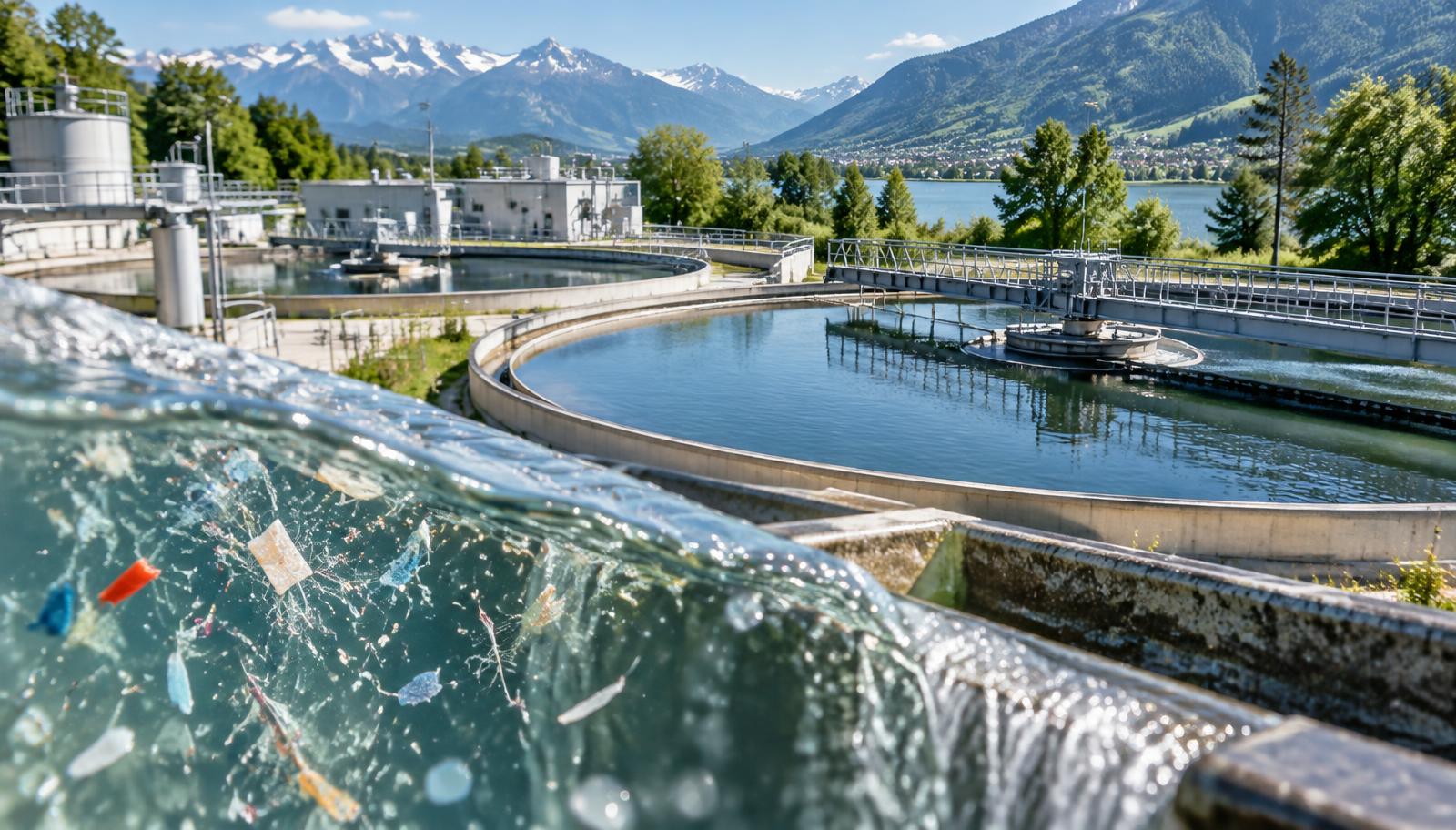
For the first time, a study has estimated at national scale the microplastic load leaving Swiss wastewater treatment plants. Led by Eawag with Empa and Agroscope and published in ACS ES&T Water, the research analysed 51 plants serving around 44% of the population.
4.7 tonnes every year
The estimated annual discharge is 4.7 tonnes of microplastics, approximately 0.5 grams per person per year. The study covered particles larger than 20 micrometres and excluded tyre wear. The authors note that the estimated atmospheric input into Swiss waters is around twice as high, while stressing that every pathway into the environment should be reduced.
51 treatment plants
First robust nationwide estimate based on measurements
0.5 g per person
Around 4.7 million grams of microplastics each year
A new way to measure
Instead of directly searching for particles dispersed in treated water, the team analysed microplastics attached to sewage-sludge flocs. Because plants routinely measure how many flocs leave with the effluent, their microplastic concentration supports a more reliable estimate of the total discharged load.
The link to Plastikóre
The findings show that even when treatment plants retain a large share of pollutants, particles can still cross the final barrier. This is precisely where Plastikóre aims to act: developing a physical, modular, chemical-free treatment to capture microfibres before effluent returns to rivers and seas.
Plastikóre's technology is currently at TRL 3-4 and has achieved 85-95% microfibre removal in laboratory validation. These project results are separate from the Swiss study: they are Plastikóre's starting point for progressing towards full-scale pilots and contributing to a new generation of quaternary treatment.
Sources: scientific paper in ACS ES&T Water, Eawag communication dated September 10, 2026, and the Ecoinventos explainer.